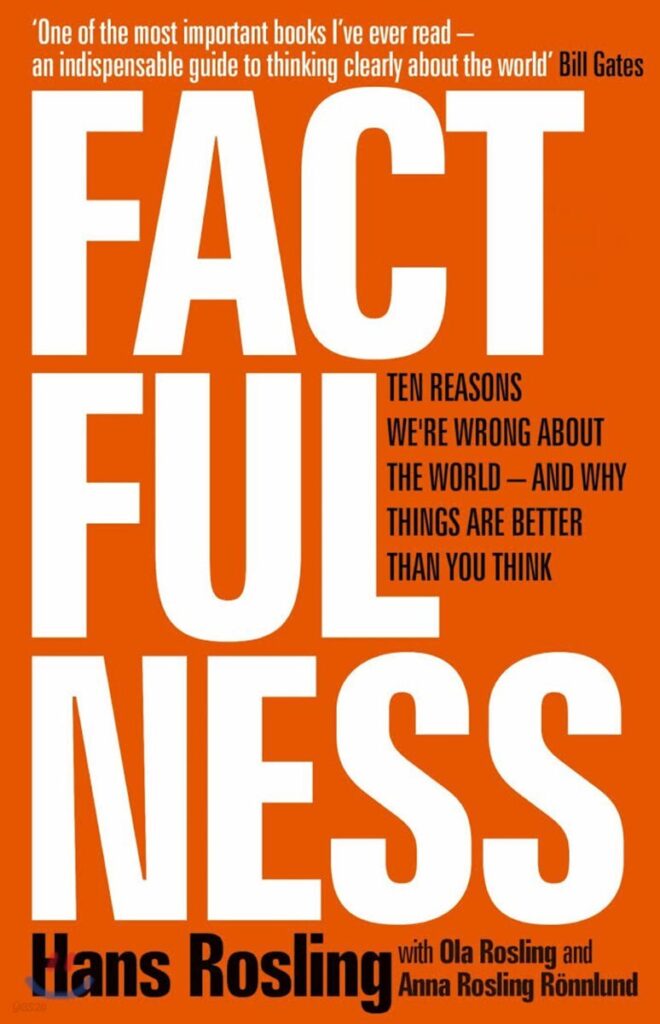
A few years ago, I decided to read the book Factfulness.
Before opening it, I looked up the meaning of the word — “the quality of being faithful to facts.”
Even that definition alone struck me deeply.
We are surrounded by information every day, yet much of what we know is filtered through bias and distortion.
Factfulness challenges that distorted view of reality.
The book begins with a series of questions:
What percentage of children in the world are vaccinated?
How many years of education do women receive compared to men?
Surprisingly, most people score worse than random guessing on these questions.
In other words, we don’t actually see the world as it really is.
That’s where the book begins its journey — to uncover the truth behind our misconceptions.
Understanding the World in Four Levels
The author divides the world into four income levels based on daily earnings.
- Level 1: less than $3 a day
- Level 2: $2–$8 a day
- Level 3: $8–$32 a day
- Level 4: more than $32 a day
We often simplify the world into “developed” and “developing” countries, but reality is more nuanced.
The majority of humanity lives in Levels 2 and 3.
If you were born into Level 4, you are part of a small, privileged group — a fact worth recognizing and being grateful for.
Why We See the World Incorrectly
Factfulness delves deeply into the cognitive biases that shape our perception.
We often believe the world is getting worse because the media tends to highlight crises and disasters.
But data tells a different story.
Take airplane crashes, for example. They are rare, yet they dominate headlines.
Meanwhile, thousands of people die every day in car accidents — an everyday tragedy that barely makes the news.
Our brains are wired to pay attention to the dramatic and unusual, not the ordinary.
As a result, we perceive rare risks as common threats and underestimate gradual progress.
The author calls this the “dramatic instinct” — our tendency to exaggerate problems and view the world through fear rather than facts.
The Right Way to See Facts: Comparison and Context
The author emphasizes that context and comparison are essential when interpreting data.
Looking at one number in isolation can be misleading.
For example, even if the number of disease cases rises, the infection rate per capita might have actually decreased as the population grew.
True understanding requires seeing data from multiple perspectives.
The book also reminds us of the 80/20 principle — most problems stem from a small portion of causes.
By focusing on the 20% that matters most, we can make meaningful progress.
Humility and Curiosity — The Path to Truth
One of the book’s most powerful messages is that we must teach our children humility and curiosity.
Humility to accept that what we believe may be wrong,
and curiosity to continue seeking better answers.
We often think, “I’m right and you’re wrong.”
But as the author reminds us:
“What we believe to be true might not actually be true.”
Understanding that others act based on their own version of “truth” helps us develop empathy and open-mindedness.
The world becomes less about proving who’s right and more about learning from each other.
What Factfulness Teaches Us
Factfulness isn’t just a book about statistics or data — it’s about transforming the way we think.
It examines events like world wars, financial crises, pandemics, climate change, and global poverty, urging us to respond to these issues with calmness and clarity based on real facts.
Seeing the world optimistically doesn’t mean being naïve.
It means being a realistic optimist — hopeful, but grounded in evidence.
Conclusion: I Might Be Wrong — And That’s Okay
When I finished reading Factfulness, one simple realization stayed with me:
“I might be wrong.”
This thought made me humble.
It reminded me that what I perceive as truth may change with new information.
That awareness alone expands the way I see the world.
Factfulness taught me how to “see through facts.”
And that skill doesn’t just help me understand data —
it helps me understand life itself.
By thinking more objectively, I can design a more positive, grounded path forward.